


 English - EN
  繁體 - ZH-TW
  简体 - ZH-CN
  Español - ES
  日本語 - JA
  العربية - AR
  Русский - RU
  Français - FR
AI Servers × EVs × Electronic Connectors Enabling Reliable Connections in the High-Performance Computing Era
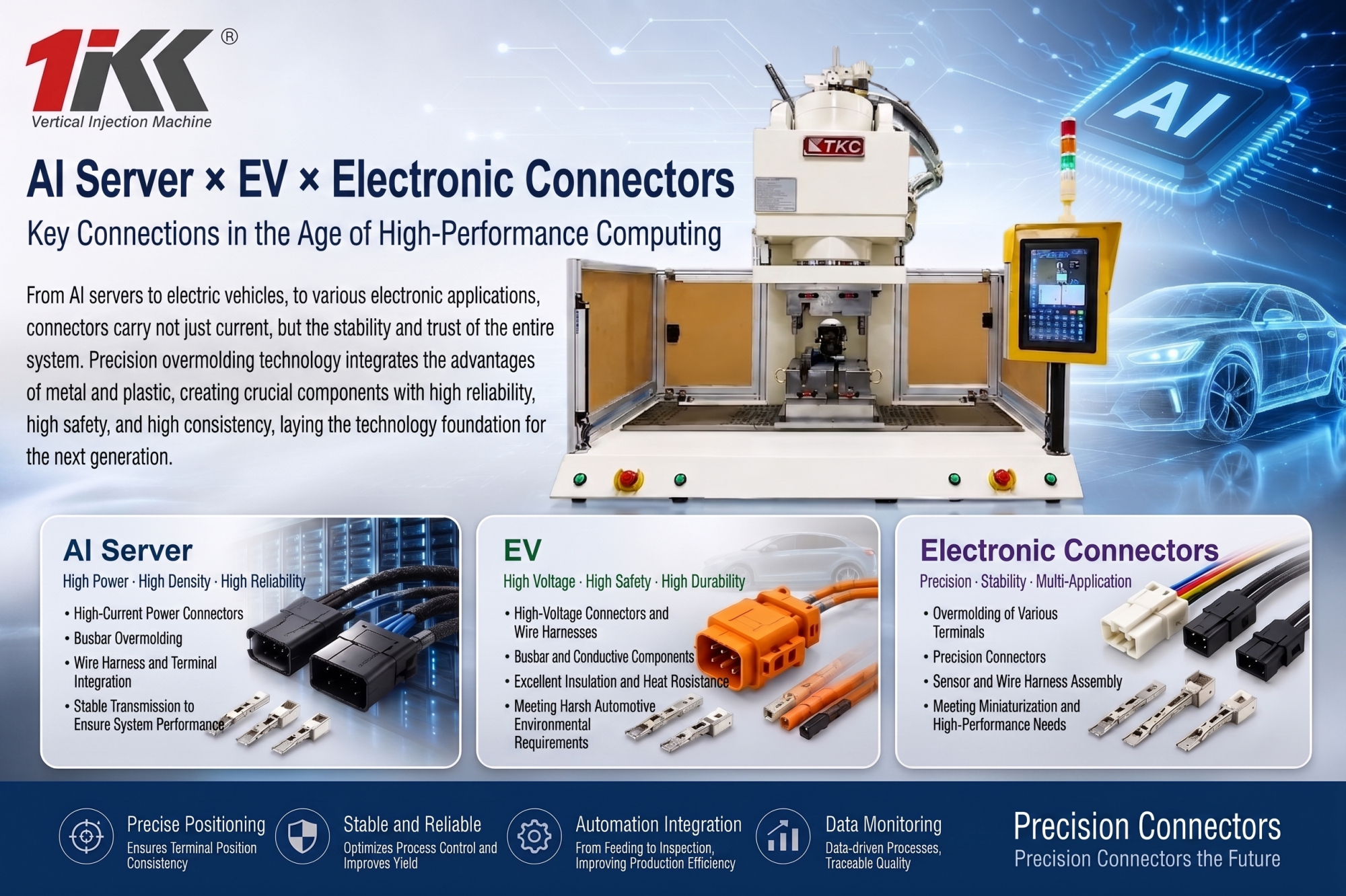
The rapid advancement of AI computing, electric vehicles (EVs), and high-speed electronic equipment has transformed “connection” from a simple means of electrical transmission into a critical factor affecting system performance and reliability. From high-current power connectors in AI servers to busbars and connectors in EV high-voltage systems, as well as terminals and wire harnesses in precision electronic devices, connection components are facing increasingly stringent requirements for higher current density, miniaturization, heat resistance, and long-term operational stability.
In high-power applications, terminals must not only carry high currents but also maintain stable contact resistance and reliable insulation performance. As a result, terminal positioning, plastic encapsulation, material selection, and stress control during the molding process all directly affect product reliability. Insert molding, in particular, integrates metal terminals, conductors, and engineered plastic structures into a single component. This process delivers excellent structural integrity, electrical insulation, and dimensional consistency while reducing the need for subsequent assembly operations.
As demand grows for highly reliable connection components in AI servers and EVs, manufacturing is no longer simply about producing a finished part. Instead, it is evolving toward precision positioning, automated pick-and-place systems, visual inspection, and process data management. From terminal feeding through final product inspection, the stability of every stage can affect the performance of the finished product.
As computing power continues to increase and vehicle electrical architectures continue to evolve, connectors are becoming more critical than ever. Reliable power transmission begins with dependable connections—and dependable connections begin with precise, controllable molding processes.






合作媒體