

 English - EN
  繁體 - ZH-TW
  简体 - ZH-CN
  Español - ES
  日本語 - JA
  العربية - AR
  Русский - RU
  Français - FR
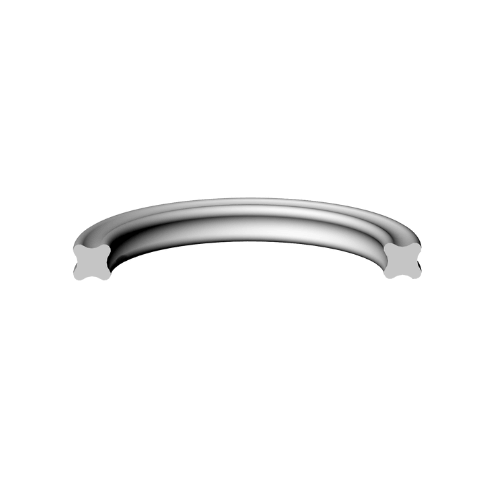
X-rings (Quad-rings)
X-rings, also known as Quad-rings, are high-performance elastomer sealing rings with a unique X-shaped cross-section.
Designed as an advanced alternative to standard O-rings, they provide superior sealing reliability in both static and dynamic applications.

Why Choose X-Rings?
The four-lobed design provides two sealing surfaces per side, requiring less squeeze to maintain an effective seal.
Lower compression force means reduced friction and wear, significantly extending the service life in dynamic applications.
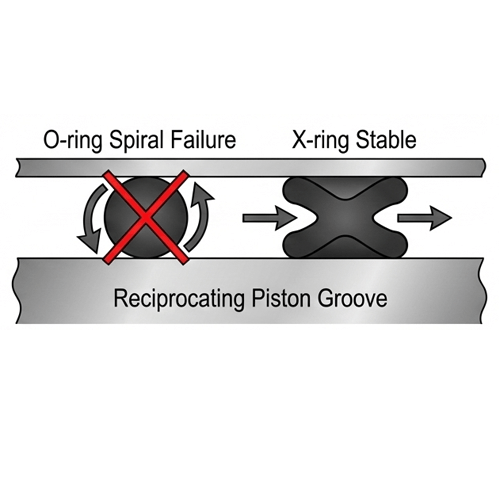
The X-profile resists "spiral failure" (rolling in the groove), a common problem for O-rings in reciprocating motions.
Detailed Technical Advantages

* X-rings feature four sealing lips to prevent leakage and reduce seal wear.
The sealing mechanism of an X-ring is based on radial or axial pre-compression, similar to a traditional O-ring, but with significant enhancements in contact stability and friction management.
Critical Performance Advantages



Why Choose X-Rings Over O-Rings?
| Feature | X-Ring (Quad-Ring) | O-Ring |
|---|---|---|
| Sealing Points | 4 Sealing Lips | 1 Sealing Line |
| Compression | Lower force required | Higher force required |
| Dynamic Stability | Anti-twist / Anti-spiral | Prone to rolling |
| Lubrication | Integrated Reservoirs | No retention feature |
| Cost Efficiency | Lower Total Cost of Ownership | Lower Initial Cost |

Choose X-Rings When:
- Dynamic or reciprocating motion is involved.
- Long service life and low friction are critical.
- Anti-spiral performance is mandatory.
- Seeking a drop-in upgrade for O-Ring grooves.

Choose O-Rings When:
- Application is purely static.
- Initial unit cost is the primary driver.
- Operating conditions are extremely simple.
Typical Applications of X-Rings


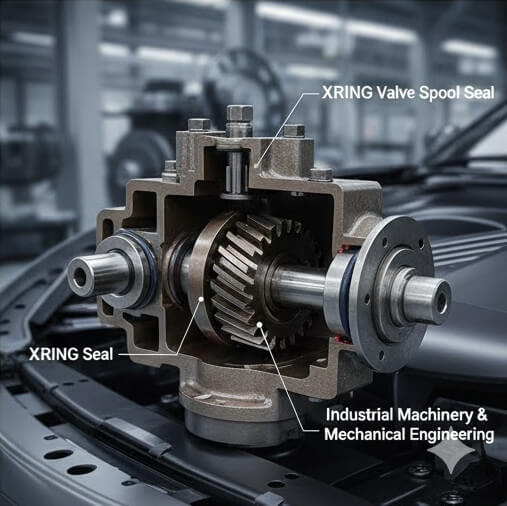
Expert Recommendation: X-rings are highly recommended for applications prone to spiral failure, uneven wear, or severe pressure fluctuations where standard O-rings typically fail.
X-Ring Material Selection Guide
| Material | Technical Features | ✔ Recommended | ✘ Not Recommended | Typical Operating Range |
|---|---|---|---|---|
| NBR Nitrile Rubber |
Superior oil resistance. High ACN improves strength but lowers low-temp flex. | Petroleum oils, Water (≤100°C), weak acids. | Ozone, glycol, aromatic fuels. | 70 Shore A: -30°C to 110°C 90 Shore A: -50°C to 120°C (High Pressure) |
| EPDM Ethylene Propylene |
Outstanding ozone & weathering. Excellent steam resistance. | Steam (≤204°C), brake fluids, ketones. | Petroleum oils, mineral lubricants. | 70 Shore A: -50°C to 150°C |
| FKM Fluoroelastomer |
Best heat & chemical resistance. Low gas permeability. | High vacuum, hydrocarbons, chemicals. | Hot steam, amines, brake fluids. | 75 Shore A: -30°C to 275°C |

X-Ring (Quad-Ring) FAQ
Advanced Sealing Technology & Performance Insights
Q3: What are the main advantages in dynamic applications?
The square-like profile prevents the seal from twisting or rolling in the groove.
The four-lobed contact points reduce friction and start-up resistance.
Q4: Are X-Rings suitable for high-pressure?
X-Rings are excellent for low-to-medium pressure. For high-pressure applications (above 50 bar / 725 psi), we strongly recommend using Back-up Rings to prevent extrusion.
Need assistance with groove dimensions or material compatibility?
Contact Technical Support